Starting digital marketing can feel confusing at first.
You open YouTube, Google, Instagram, LinkedIn, or TikTok, and suddenly everyone is talking about SEO, Meta Ads, Google Ads, email marketing, copywriting, funnels, landing pages, analytics, content strategy, branding, automation, and a hundred other things.
And if you are completely new, it is very easy to think: where should I even start?
That is exactly why this roadmap exists.
This is not a complicated expert guide filled with words nobody uses in real life. This is a practical roadmap for beginners who want to understand digital marketing basics, learn what matters first, and build a clear path instead of jumping randomly from one topic to another.
If you are wondering how to learn digital marketing without experience, how to do digital marketing for beginners, or what you should learn first in digital marketing, this article will give you a simple structure.
You do not need to master everything immediately. You just need to understand the big picture, learn the basics properly, and then move step by step.
What is digital marketing?
Digital marketing is the process of promoting products, services, brands, content, or ideas through online channels.
Those channels can include:
- search engines like Google
- social media platforms like Instagram, LinkedIn, TikTok, Facebook, and YouTube
- websites and landing pages
- email newsletters
- paid ads
- blogs and educational content
- online communities
- video content
But digital marketing is not only about posting online.
At its core, digital marketing is about understanding people and communicating with them in the right place, with the right message, at the right time.
Sometimes that message is a blog post. Sometimes it is a short video. Sometimes it is a Google search result. Sometimes it is a Facebook ad. Sometimes it is an email. Sometimes it is a landing page that explains an offer clearly.
The format changes, but the basic goal stays the same: get attention, build trust, create interest, and guide people toward an action.
Why digital marketing matters in 2026
Digital marketing matters because people now discover, compare, research, and buy through digital channels.
Before someone buys a product, signs up for a service, watches a video, contacts a company, or follows a creator, they usually interact with digital content first.
They might search on Google. They might watch a YouTube tutorial. They might read a blog post. They might see a social media post. They might click an ad. They might check reviews. They might compare different options.
This means businesses, creators, freelancers, and personal brands need to understand how people behave online.
In 2026, digital marketing is not just about being present online. Almost everyone is present online. The real challenge is learning how to be clear, useful, consistent, and easy to understand.
That is why the basics still matter so much.
Tools will change. Platforms will change. Algorithms will change. But the foundation stays the same: know your audience, create value, communicate clearly, and measure what happens.
The simple digital marketing roadmap for beginners
If you are just starting, the biggest mistake you can make is trying to learn everything at once.
You do not need to become an SEO expert, media buyer, copywriter, designer, analyst, email marketer, and content strategist in the same month.
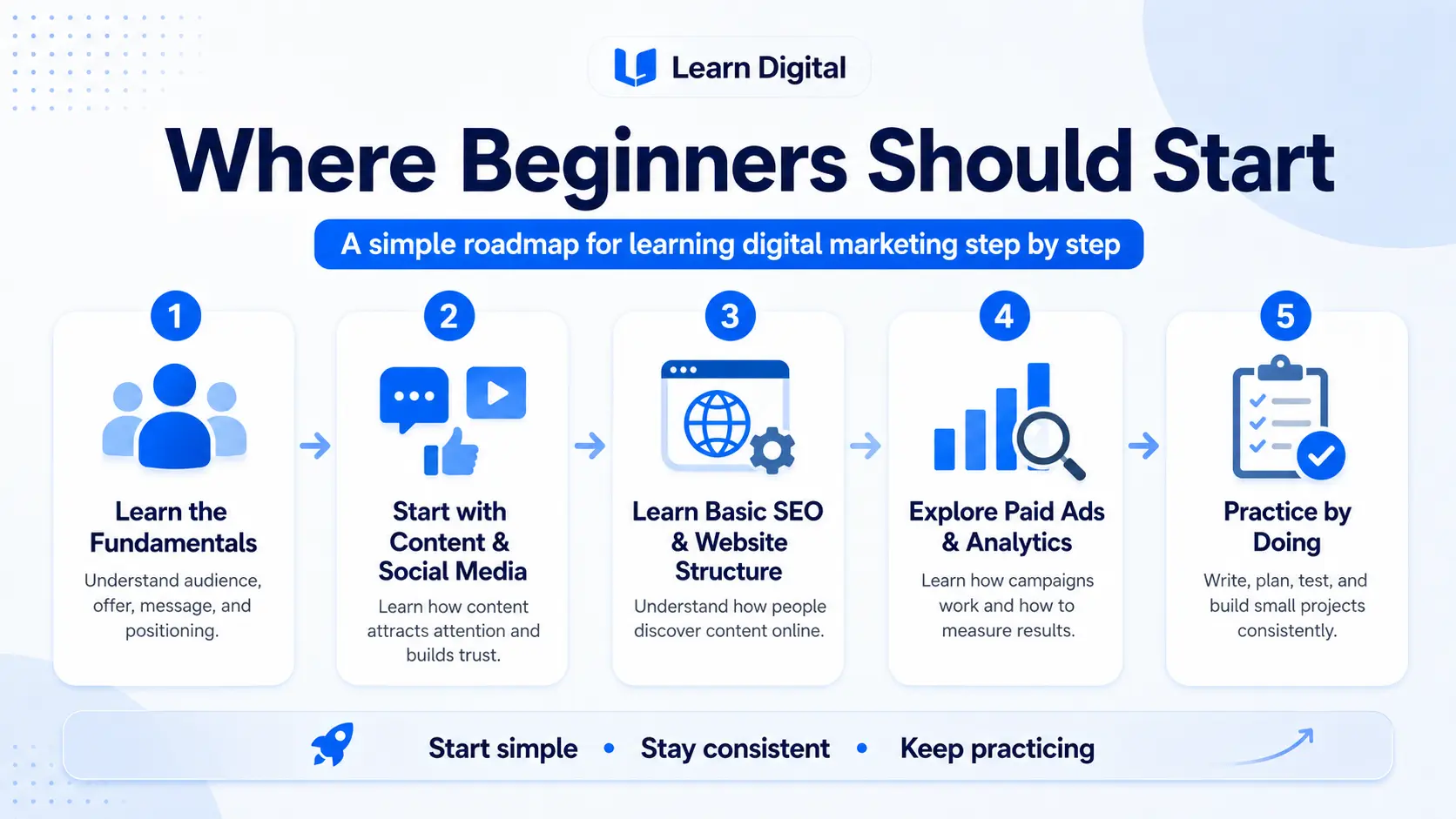
A better approach is to follow a simple learning order:
- Step 1: Understand marketing fundamentals
- Step 2: Learn the main digital marketing channels
- Step 3: Learn content and communication basics
- Step 4: Understand websites and landing pages
- Step 5: Learn SEO basics
- Step 6: Learn social media marketing
- Step 7: Learn paid ads basics
- Step 8: Learn email marketing
- Step 9: Learn analytics and reporting
- Step 10: Practice with real or small personal projects
This roadmap gives you structure. It helps you avoid learning random things in a random order.
You can still explore different areas, of course. But when you understand the order, digital marketing starts feeling much less overwhelming.
Step 1: Learn marketing fundamentals first
Before you learn tools, platforms, ads, dashboards, or content formats, you should first understand the basic logic of marketing.
This is the part many beginners skip, but it is also the part that makes everything else easier later.
Marketing fundamentals answer questions like:
- Who are we trying to reach?
- What problem does this person have?
- What does this person want?
- Why should they care about this product, service, or content?
- What message would make sense to them?
- What action do we want them to take?
These questions matter in every channel.
If you write a blog post, you need to know who it is for. If you create a social media post, you need to know why someone would stop and read it. If you run a Facebook ad, you need to know what message will make someone click. If you build a landing page, you need to know what problem you are solving.
This is why digital marketing is not just about learning buttons inside platforms.
Platforms are tools. Marketing thinking is the foundation.
The three beginner concepts you should understand early
If you remember only three marketing terms in the beginning, remember these: audience, offer, and message.
Audience
Your audience is the group of people you are trying to reach.
A beginner mistake is saying: my audience is everyone.
That almost never works.
Good marketing becomes easier when you know who you are talking to. A student learning digital marketing needs a different message than a business owner, a freelancer, or a marketing manager.
Offer
Your offer is what you are presenting to people.
It can be a product, service, newsletter, video, free guide, course, consultation, tool, or anything else you want people to care about.
A good offer should be clear. People should quickly understand what it is and why it matters.
Message
Your message is how you explain the offer to the audience.
This is where copywriting, content, ads, headlines, captions, and landing pages become important.
A strong message connects what you offer with what the audience actually cares about.
Step 2: Understand the main digital marketing channels
Once you understand the basic idea of marketing, the next step is to learn the main digital channels.
A digital marketing channel is simply a place or method you use to reach people online.
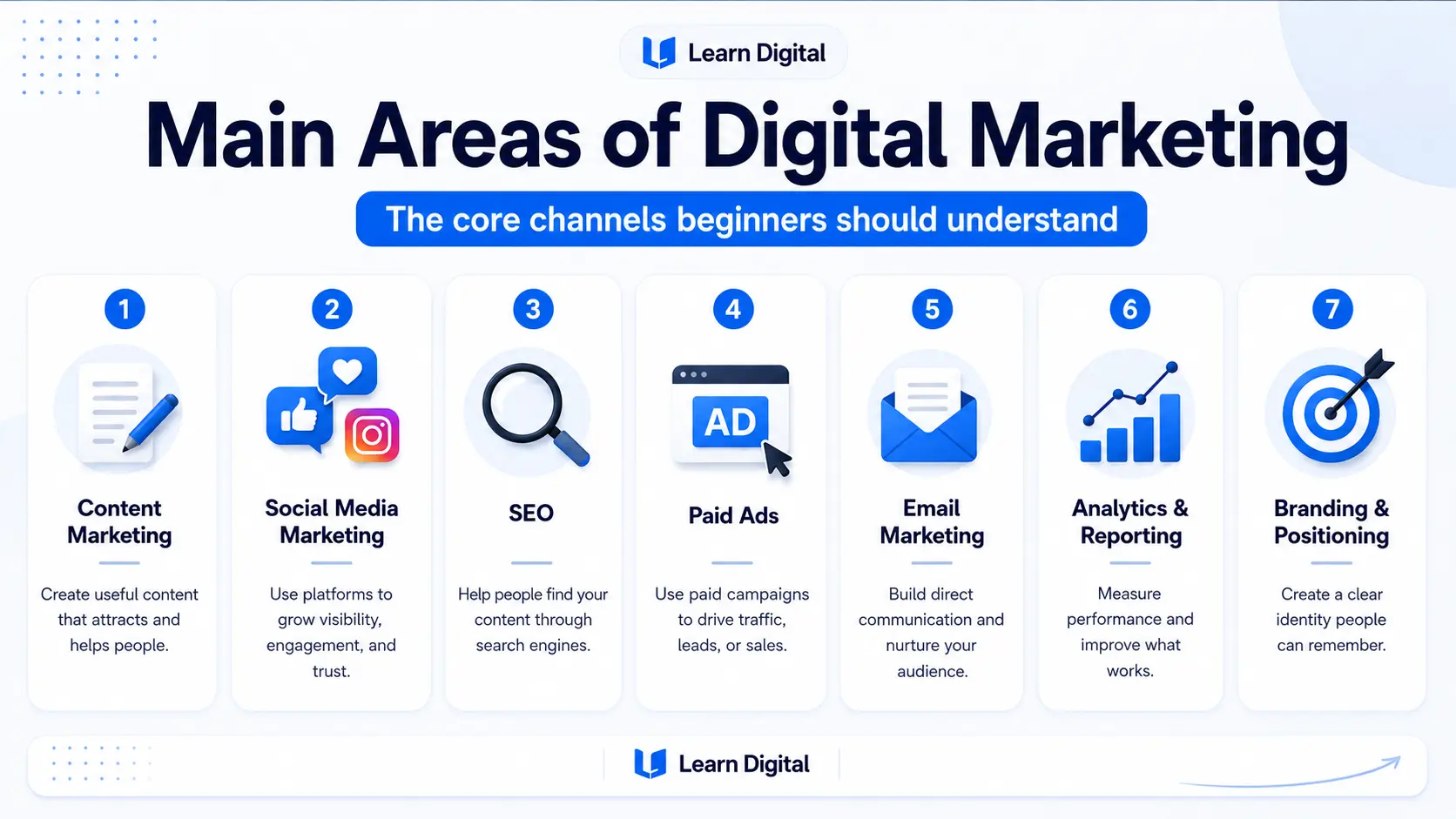
The main channels beginners should understand are:
- SEO
- content marketing
- social media marketing
- paid advertising
- email marketing
- website and landing page marketing
- analytics and reporting
You do not need to become an expert in all of them immediately.
But you should understand what each channel does and how it fits into the bigger picture.
SEO
SEO means Search Engine Optimization.
It helps people find your content through search engines like Google. For example, if someone searches for “digital marketing basics for beginners” and your article appears in the results, that traffic is coming from SEO.
SEO is useful because people are already searching for answers. You are not interrupting them. You are helping them find what they are looking for.
If you want a deeper beginner explanation, you can also read: SEO Basics for Beginners Who Want More Organic Traffic.
Content marketing
Content marketing is about creating useful content that attracts, educates, or helps your audience.
This can include blog posts, videos, guides, tutorials, carousels, newsletters, podcasts, case studies, templates, and more.
Good content builds trust. It helps people understand a topic better and gives them a reason to come back.
Social media marketing
Social media marketing is about using platforms like Instagram, LinkedIn, TikTok, Facebook, YouTube, and X to grow visibility and build relationships with an audience.
But social media marketing is not just posting randomly.
It is about understanding what kind of content works on each platform, what your audience cares about, and how to communicate in a way that feels natural there.
Paid advertising
Paid advertising means paying platforms to show your message to people.
The most common examples are Google Ads, Meta Ads, LinkedIn Ads, TikTok Ads, and YouTube Ads.
Paid ads can bring faster visibility than organic channels, but they can also waste money quickly if your targeting, offer, message, or landing page is weak.
Email marketing
Email marketing means building a list of subscribers and communicating with them directly through email.
This can be used for newsletters, educational sequences, product updates, lead nurturing, offers, announcements, and relationship building.
Email is powerful because you are not fully dependent on an algorithm. You have a more direct connection with your audience.
Websites and landing pages
Your website is often the place where people go when they want to learn more about you, your business, your content, or your offer.
A landing page is a focused page created for one specific goal. That goal can be to collect leads, sell a product, explain a service, invite people to book a call, or promote a resource.
Websites and landing pages connect many other channels together. Ads, SEO, social media, and email often send people back to a website.
Analytics and reporting
Analytics is how you understand what is happening.
You look at data like traffic, clicks, views, engagement, leads, conversions, bounce rate, watch time, open rates, and sales.
Without analytics, you are guessing. With analytics, you can make better decisions.
Step 3: Learn content and copywriting basics
If you are a beginner, content and copywriting are two of the most useful skills you can start learning early.
Content helps you educate and attract people. Copywriting helps you communicate clearly and persuade people to take action.
You do not need to become a professional writer immediately. But you should practice writing clearly.
In digital marketing, writing appears everywhere:
- website headlines
- blog articles
- social media captions
- video titles
- YouTube descriptions
- email subject lines
- ad copy
- landing page sections
- calls to action
This is why communication is such an important skill.
How to write Facebook ads as a beginner
Many beginners specifically ask how to write Facebook ads, because Meta Ads are often one of the first paid advertising platforms people explore.
The simple structure is:
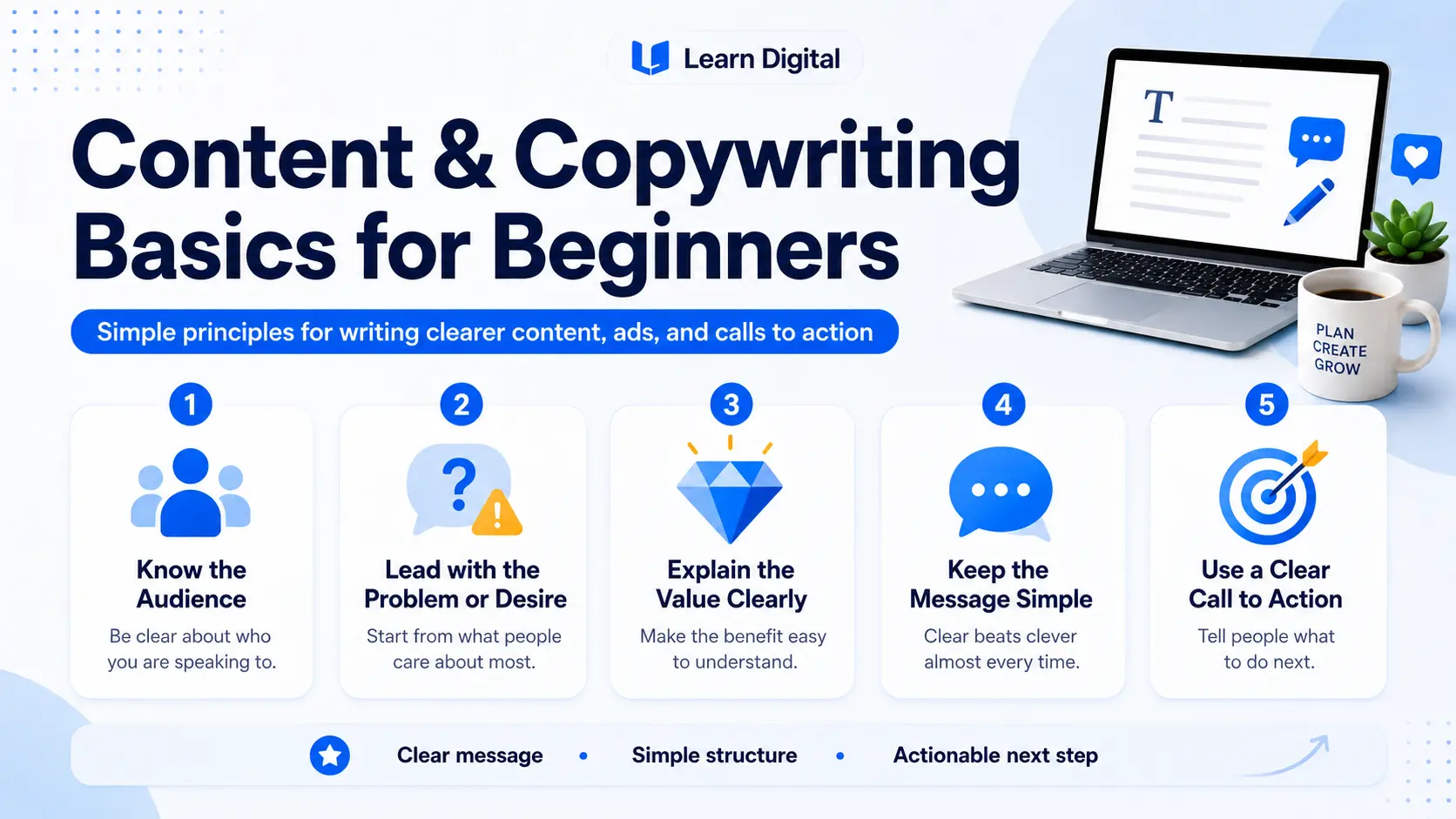
- Start with the problem or desire
- Explain the value clearly
- Keep the message simple
- Use a clear call to action
For example, instead of writing something vague like:
“We offer high-quality digital marketing services.”
A clearer beginner-style ad could say:
“Struggling to get more leads online? Learn how a simple digital marketing strategy can help your business attract the right people.”
The second version is better because it speaks to a problem and makes the value easier to understand.
Good ad copy is not about sounding fancy. It is about being clear, relevant, and specific.
Step 4: Learn SEO basics
SEO is one of the best digital marketing areas to learn because it teaches you how people search, how topics work, and how content gets discovered.
As a beginner, you do not need to start with advanced technical SEO.
Start with the basics:
- what keywords are
- what search intent means
- how to write a clear title
- how to write a useful meta description
- how to structure a blog post with headings
- how to link between related articles
- how to create content that answers real questions
Search intent is especially important.
Search intent means the reason behind a search.
If someone searches “digital marketing terms for beginners,” they probably want a simple explanation of common terms.
If someone searches “digital marketing courses for beginners,” they are probably comparing learning options.
If someone searches “how to start learning digital marketing,” they want a roadmap.
The better you understand intent, the easier it becomes to create helpful content.
Step 5: Learn social media marketing basics
Social media is often where many beginners start because it feels familiar.
You already use platforms like Instagram, TikTok, YouTube, LinkedIn, or Facebook, so it can feel easier to understand than SEO or analytics at first.
But using social media as a person and using social media as a marketer are not the same thing.
As a marketer, you need to think about:
- who the content is for
- what the content is trying to achieve
- why someone would stop scrolling
- what format fits the platform
- how often you can post realistically
- what content themes you want to repeat
- how to turn attention into trust
A common beginner mistake is thinking consistency means posting anything just to stay active.
But real consistency means showing up with a clear direction.
You can post less often and still do better if your content is useful, focused, and easy to understand.
Step 6: Learn paid ads basics
Paid ads are exciting because they can bring traffic faster than organic channels.
But they are also risky if you do not understand the basics.
Many beginners think paid ads are only about targeting. Targeting matters, but it is not the whole story.
A paid ad usually needs four things to work:
- a clear audience
- a strong offer
- a relevant message
- a good landing page or next step
If any of these parts are weak, the campaign can struggle.
For example, you can have perfect targeting, but if the ad message is boring, people will not click. You can have a good ad, but if the landing page is confusing, people will leave.
This is why paid ads should not be your first and only learning area. They make more sense once you already understand audience, offer, message, and content.
Step 7: Learn email marketing basics
Email marketing is one of the most underrated areas for beginners.
Social media platforms can change. Reach can go up and down. Algorithms can make content harder to distribute.
But with email, you build a direct connection with people who chose to hear from you.
A simple beginner email marketing system usually includes:
- a newsletter signup form
- a reason for people to subscribe
- a welcome email
- regular helpful emails
- clear links back to your content, tools, or offers
You do not need a complicated automation system at the start.
If you can send one useful email per week, that is already a good beginning.
The key is to avoid sending emails only when you want something from people. A good newsletter should give value, not just promote.
Step 8: Learn analytics and reporting
Analytics can feel scary in the beginning because it looks technical.
But you do not need to understand every report immediately.
Start with simple questions:
- How many people visited the website?
- Where did they come from?
- Which pages did they visit?
- Which content performed best?
- How long did people stay?
- Did people click, subscribe, contact, or buy?
These questions help you understand performance.
Analytics is not about staring at numbers for no reason. It is about learning what happened and deciding what to improve next.
For example:
- If a blog post gets traffic but no clicks, maybe the call to action needs improvement.
- If a page gets visits but people leave quickly, maybe the content is not clear enough.
- If a video gets views but low watch time, maybe the intro is too slow.
- If an ad gets clicks but no conversions, maybe the landing page does not match the ad.
This is where digital marketing becomes practical. You create something, measure what happens, and improve it.
Digital marketing terms for beginners
When you are new, the amount of terminology can feel overwhelming.
Here are some simple explanations of common digital marketing terms for beginners.
Traffic
Traffic means people visiting your website, landing page, blog, or other digital property.
Conversion
A conversion happens when someone takes the action you wanted them to take. That could be subscribing, buying, filling out a form, downloading something, or booking a call.
CTR
CTR means click-through rate. It shows what percentage of people clicked after seeing your link, ad, email, or search result.
CPC
CPC means cost per click. It tells you how much you pay on average when someone clicks your ad.
CPA
CPA means cost per acquisition or cost per action. It shows how much it costs to get one desired result, like one lead or one sale.
Impressions
Impressions show how many times your content, ad, or search result was shown.
Engagement
Engagement includes actions like likes, comments, shares, saves, replies, clicks, and other interactions.
Landing page
A landing page is a focused page built around one goal. It is often used in paid ads, email campaigns, or lead generation.
Lead
A lead is a person who has shown interest, usually by submitting contact information, signing up, or requesting more details.
Funnel
A funnel is the path someone goes through from discovering you to taking action. It often includes awareness, interest, consideration, and conversion.
What should I learn first in digital marketing?
If you are starting from zero, learn this order:
- Basic marketing thinking
- Audience, offer, and message
- Content and copywriting basics
- SEO basics
- Social media marketing basics
- Website and landing page basics
- Paid ads basics
- Email marketing basics
- Analytics and reporting basics
This does not mean you have to master each topic before moving to the next one.
It simply means this order gives you a better foundation.
Content and copywriting help you communicate. SEO helps you understand search intent. Social media helps you understand attention. Websites help you understand user experience. Paid ads help you understand testing and performance. Email helps you understand relationship building. Analytics helps you understand results.
Together, these skills give you a strong digital marketing base.
How to learn digital marketing without experience
You can absolutely learn digital marketing without experience.
But you need to do more than watch tutorials.
Watching videos and reading articles is useful, but real learning starts when you apply what you learn.
Here are practical ways to learn without experience:
Create a simple personal project
This can be a blog, Instagram page, YouTube channel, newsletter, small website, or mock brand.
The point is not to make it perfect. The point is to practice.
Write practice content
Write blog titles, meta descriptions, social media captions, email subject lines, ad copy, and landing page sections.
Writing is one of the fastest ways to improve your thinking.
Study real brands
Look at brands you like and ask:
- What are they saying?
- Who are they talking to?
- What content do they repeat?
- What offer are they promoting?
- How do they structure their website?
- What kind of ads are they using?
Build simple examples for your portfolio
You do not need a client immediately.
You can create sample work:
- a sample content calendar
- a mock SEO article outline
- a sample Facebook ad
- a sample email newsletter
- a simple landing page wireframe
- a basic reporting template
This helps you move from theory to practice.
Do you need digital marketing courses for beginners?
A course can help, but it is not magic.
Digital marketing courses for beginners are useful when they give you structure, examples, and practical exercises.
But a course alone will not make you good.
What matters is how you use it.
If you take a course, do not just watch passively. Pause, take notes, apply the lesson, create examples, and test what you learn.
A good digital marketing for beginners course should explain:
- marketing fundamentals
- main channels
- SEO basics
- content strategy
- social media marketing
- paid ads basics
- email marketing
- analytics
- practical examples
But do not wait until you find the perfect course to begin.
Start with free resources, practice small tasks, and build your understanding step by step.
Common beginner mistakes in digital marketing
Beginners usually do not fail because digital marketing is impossible. They struggle because they learn without structure.
Here are the most common mistakes to avoid.
Trying to learn everything at once
This is probably the biggest one.
If you try to learn SEO, paid ads, email marketing, design, analytics, automation, and social media all at the same time, you will probably feel overwhelmed.
Learn the big picture first, then go deeper one area at a time.
Only consuming content
Watching tutorials feels productive, but it is not enough.
You need to practice. Create, write, test, publish, analyze, and improve.
Chasing hacks too early
Beginners often look for shortcuts before they understand the basics.
But hacks do not help much if you do not understand audience, offer, message, content, and measurement.
Ignoring analytics
Analytics does not need to be complicated. But you should learn to check basic performance.
If you never look at results, you will not know what is working.
Copying without understanding
Studying other brands is useful. Blind copying is not.
Try to understand why something works before using a similar idea.
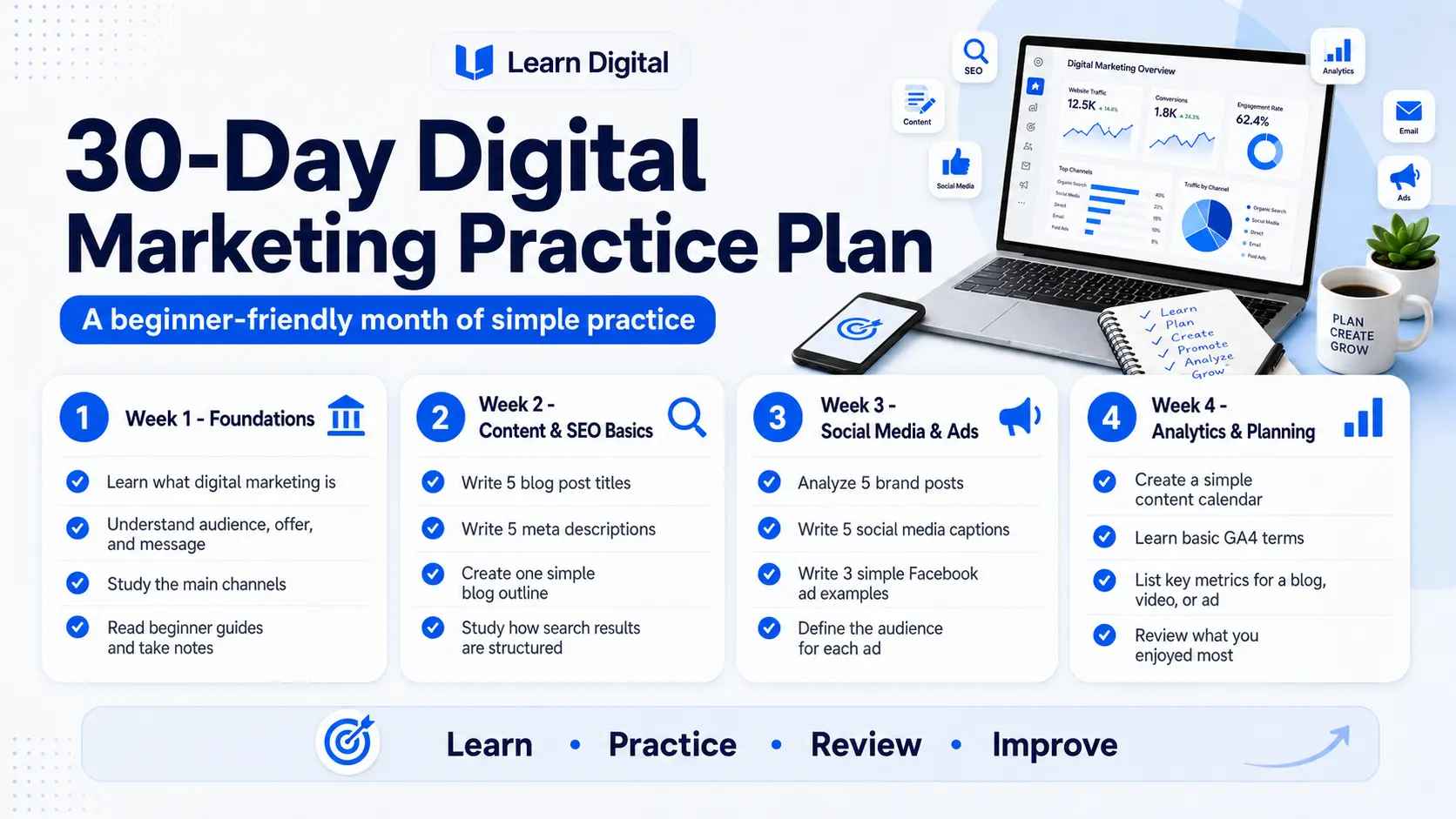
A simple 30-day practice plan for beginners
If you want a practical starting point, here is a simple 30-day plan.
Week 1: Learn the foundations
- Learn what digital marketing is
- Understand audience, offer, and message
- Study the main digital marketing channels
- Read beginner articles and take notes
Week 2: Practice content and SEO basics
- Write five blog post title ideas
- Write five meta descriptions
- Create one simple blog outline
- Study how Google search results are structured
Week 3: Practice social media and ads
- Analyze five social media posts from brands you like
- Write five social media captions
- Write three simple Facebook ad examples
- Think about what audience each ad is targeting
Week 4: Practice analytics and planning
- Create a simple content calendar
- Learn basic Google Analytics 4 terms
- List what metrics you would track for a blog, video, or ad
- Review what you enjoyed most during the month
After 30 days, you will not be an expert. But you will understand much more than someone who only watched random videos.
More importantly, you will have started building real marketing habits.
Which digital marketing area should you choose?
You do not need to choose your final path immediately.
But after you learn the basics, you will probably start noticing what you enjoy most.
Here is a simple way to think about it:
- If you enjoy writing and explaining things, explore content marketing and copywriting.
- If you enjoy search behavior and long-term traffic, explore SEO.
- If you enjoy platforms, trends, and community, explore social media marketing.
- If you enjoy testing, numbers, and campaigns, explore paid ads.
- If you enjoy structure and user journeys, explore email marketing and funnels.
- If you enjoy data and performance, explore analytics and reporting.
- If you enjoy big-picture thinking, explore digital marketing strategy.
There is no perfect path for everyone.
The best path is usually the one where your interest and your strengths meet.
Digital marketing tools beginners should know
Tools can help, but remember this: tools do not replace understanding.
Still, beginners should slowly become familiar with tools like:
- Google Analytics 4 for website analytics
- Google Search Console for SEO performance
- Canva for simple design
- Meta Business Suite for Facebook and Instagram management
- Google Ads for search and display campaigns
- Mailchimp or Brevo for email marketing
- Google Sheets for planning and reporting
- ChatGPT for brainstorming, outlines, and content support
Do not try to learn every tool at once.
Learn tools when they support what you are practicing.
For example, if you are learning SEO, start with Google Search Console. If you are learning analytics, start with Google Analytics 4. If you are learning content planning, start with a simple spreadsheet.
How long does it take to learn digital marketing?
This depends on how much time you spend learning and practicing.
You can understand the basic concepts in a few weeks.
You can become comfortable with beginner tasks in a few months.
But becoming truly good takes longer because digital marketing is practical. You improve by doing, reviewing, and adjusting.
A realistic beginner timeline could look like this:
- First month: understand the main concepts and channels
- Months 2 to 3: practice content, SEO, social media, and basic analytics
- Months 4 to 6: build small projects and choose one area to explore deeper
- After 6 months: start developing stronger specialization and portfolio examples
The exact timeline is different for everyone.
What matters more than speed is consistency.
How to stay consistent while learning
Digital marketing becomes easier when you stop treating learning like a huge one-time task.
You do not need to study for six hours every day.
Even 30 to 60 minutes a day can make a big difference if you use that time well.
A simple weekly routine could be:
- one day learning a new concept
- one day practicing writing or content
- one day studying real examples
- one day learning a tool
- one day reviewing what you created
The goal is not perfection. The goal is progress.
Small consistent practice beats random motivation.
Final thoughts
Digital marketing for beginners can look overwhelming from the outside.
But once you break it down, it becomes much easier to understand.
Start with the basics. Learn audience, offer, and message. Understand the main channels. Practice content and copywriting. Learn SEO, social media, paid ads, email marketing, websites, and analytics step by step.
Do not rush. Do not compare your beginning to someone else’s experience. Do not wait until you feel completely ready.
The best way to learn digital marketing is to start simple and keep building.
Read, watch, practice, create, measure, and improve.
That is the real roadmap.
You do not need to know everything today. You just need to take the next step and keep going.
Start with the foundations. Stay curious. Practice consistently.
That is how digital marketing starts making sense.