Google just dropped an official guide on how to make your website show up in those AI Overviews and AI Mode results you've been seeing at the top of search pages. Good news, bad news.
The good news: most of what you already know about SEO still works.
The bad news... well, there isn't really bad news. But there's a big honest "we're all figuring this out as we go" hanging over the whole thing, and I want to talk about that before we get into the practical bits.
First, a quick reality check
This guide comes straight from Google, which makes it the most authoritative source we have right now. But "most authoritative" isn't the same as "complete." AI Search is months old, not years. Nobody, including Google's own engineers I'd bet, has a fully proven playbook yet. The data is thin. Best practices are still being shaped by people testing things, sharing results, and arguing about them on LinkedIn.
So treat this post (and Google's whole guide, honestly) as a solid starting point, not the final word. Things are going to change. I'll be the first to update what I write here when they do.
Okay, into the actual content.
SEO isn't dead. It's wearing a slightly different hat
Here's the main finding from Google's guide: the AI features on Search are built on top of the same search index and ranking systems that already exist. When the AI hands someone an answer, it's pulling from web pages it indexed using the regular Search machinery.
What that means for you: if your SEO basics are solid, you're already most of the way there. The people selling "AEO" (Answer Engine Optimization) and "GEO" (Generative Engine Optimization) courses for $497 are mostly repackaging SEO with a fancier label and a bigger price tag.
Don't get me wrong, the terms exist for a reason and some new techniques will emerge. But the foundation is the same one we've been working with all along.
Write things only you can write
This is the single biggest takeaway, and the one I think most beginners get wrong.
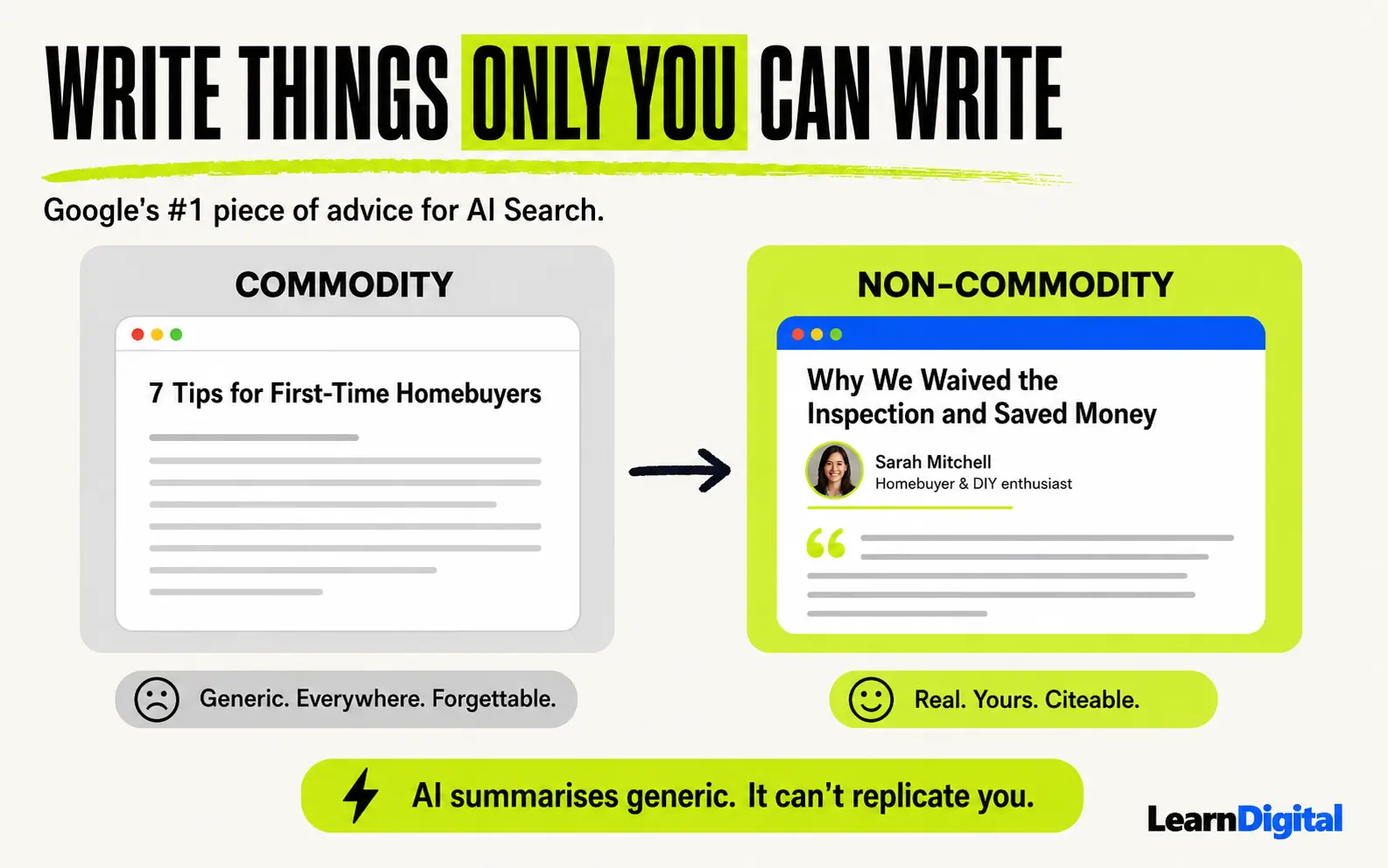
Google specifically calls out the difference between "commodity content" and "non-commodity content." A commodity piece is something anyone could write because the information is already everywhere. Their example: "7 Tips for First-Time Homebuyers." You've seen that article 400 times.
Their example of non-commodity content: "Why We Waived the Inspection and Saved Money: A Look Inside the Sewer Line." See the difference? One is a generic listicle. The other is somebody's actual experience that you can't get anywhere else.
If you're a beginner in digital marketing, this might feel a bit scary because you might be thinking "but I'm a beginner, what do I know that nobody else knows?" Honestly? More than you think. Your beginner perspective IS non-commodity content. The struggles you had, the mistakes you made, the dumb things you tried first... seasoned experts have forgotten how to talk about that stuff. Write the post you wish someone had written for you a year ago.
The AI can summarize generic advice on its own. It doesn't need your help with that part.
Make sure Google can actually read your site
The technical side hasn't changed much. Your pages need to be crawlable and indexable, your site needs to work well on phones, your content needs to load quickly enough that people don't bounce. The usual stuff.
One thing Google explicitly says: you don't need perfect HTML. Most of the web isn't valid HTML and Google parses it fine. Use semantic tags when you can because it helps screen readers and other tools, but don't lose sleep over it.
If you've never verified your site in Search Console, do that this week. It's free and it's how you find out when something on your site is broken.
The myths you can stop worrying about
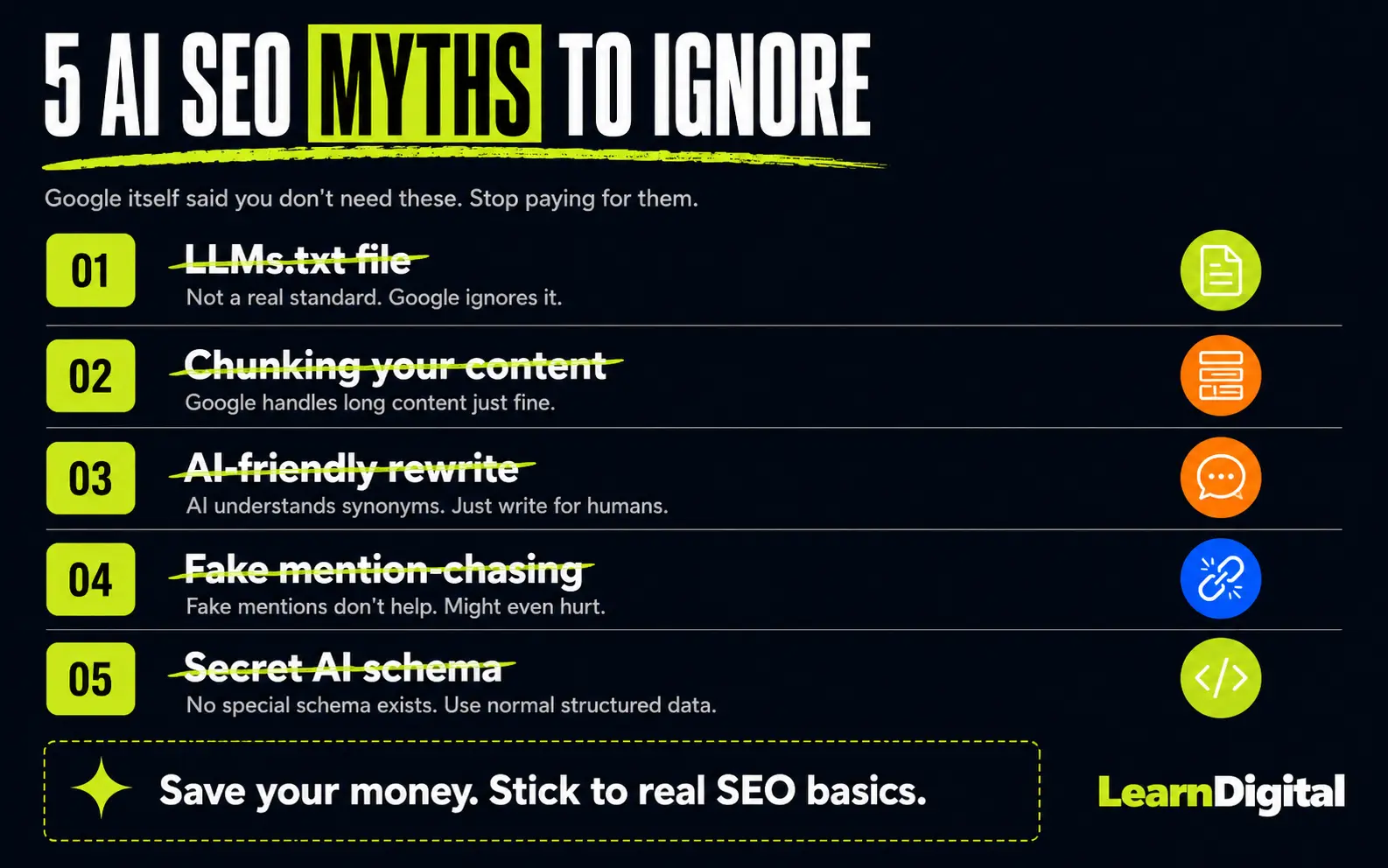
This is the part I enjoyed most, because Google is basically saying "please stop falling for this stuff." A quick rundown of what you do NOT need to do:
You don't need an LLMs.txt file. You may have seen articles claiming this is the new robots.txt for AI. Google says nope.
You don't need to "chunk" your content into tiny pieces for AI to understand it. Their systems already handle nuance and length variation just fine.
You don't need to rewrite everything in a special "AI-friendly" voice. AI understands synonyms. Just write for humans, like you've always (hopefully) been doing.
You don't need to chase mentions across the web in some weird link-building-but-for-mentions scheme. Fake mentions don't help and might actually hurt you.
You don't need any special schema markup just for AI. Structured data is still useful for rich results, so keep using it as part of normal SEO, but there's no secret AI schema.
If anyone is selling you a course on any of these things, keep your money for something useful, like a Search Console certification or a decent coffee subscription.
Quick note for local businesses and shops
If you run a local business or sell products, the AI features can pull in product listings and business info. Google's pointing people to Merchant Center for ecommerce stuff and Google Business Profiles for local. If you haven't set those up, that's probably a higher-impact use of an afternoon than rewriting your blog posts.
The honest takeaway
If I had to squeeze the whole guide into one sentence: keep doing good SEO, keep writing content that comes from your actual experience, and ignore most of what people are calling "AI SEO secrets" right now.
But please, please remember that this field is moving fast. What I'm writing today might need an update by next quarter. I'm learning this stuff alongside you, and I'm going to keep testing, reading, and sharing what works (and what flops). If you try something that surprises you, in either direction, I'd love to hear about it.
We're all the first generation of people doing SEO in the AI Search era. Mistakes are part of the deal. Let's just try not to make the expensive ones.