If you're brand new to social media marketing in 2026, welcome. You picked the loudest, most algorithm-shifty, most-changes-every-six-weeks part of digital marketing as your starting point. Bold move. I respect it.
This post is the full beginner walk-through: what social media marketing is, how to plan it, what to post, how often to post, how to actually grow, what mistakes to avoid, and a small checklist you can use before publishing. By the end you'll have a starter system you can run for the next six months without needing to read another guide.
A quick honest note before we dig in. Social media was the first thing I did in my digital marketing journey, and I'm still doing it today. The biggest lesson I keep relearning is that these channels do not give you fast results. You need time to build a content strategy. Time to test it. Time to figure out which formats your audience actually responds to. You need to show up consistently, mix different types of content, gather data, and only then start to see steady results. So if month one or two or three doesn't bring the traction you hoped for, don't get discouraged. The algorithms are hard. Pick a few content types, test them, see what your audience likes, and double down on what works. Patience, consistency, and paying attention to data are the real backbone of every social platform out there. Algorithms change. Quality content that helps your audience? That part always wins.
What social media marketing actually is (in plain English)
Social media marketing is using platforms like Instagram, TikTok, Facebook, YouTube, LinkedIn, Pinterest, and X to reach the people you want to talk to. That can mean building brand awareness, driving traffic to your website, selling directly inside the app, providing customer support, or just showing up where your audience already spends time.
A thing that changed since 2023 worth flagging: social platforms are now also search engines. 41% of Gen Z turns to social media first for search, ahead of Google. On TikTok specifically, 65% of Gen Z have used TikTok as a search engine (Adobe 2026). On Instagram that figure is around 67% per recent Forbes/GWI data. Practical translation: your posts and your profile are not just floating in a feed. They're showing up when someone types "best running shoes for flat feet" into TikTok search at 11 pm. So how you write your captions and your bio matters more than people realize.
Before you post anything, pick one platform
I know. Every guide says "be everywhere." It's bad advice, especially for beginners.
If you try to run Instagram, TikTok, YouTube, LinkedIn, Pinterest, and a newsletter at the same time as one person with a normal life, you will produce mediocre content on six platforms and quit within two months. I've seen it happen more times than I can count. I've done it myself more times than I'd like to admit.
Pick one platform first. Get comfortable making content there. Once you've found what works, you can repurpose into a second platform with maybe 30% extra effort. Buffer's 2026 creator growth study found that creators who posted in 20 or more of those weeks saw around 450% more engagement per post than creators who only posted in 4 weeks or fewer. The number that grows you is "how many weeks did I show up," not "how many platforms did I try at once."
How to pick a starting platform:
- Where does your audience already spend time? (A 60-year-old plumbing supply buyer is not on TikTok. An 18-year-old skincare shopper is.)
- What format do you like making? Don't pick TikTok if you hate being on camera. You'll quit.
- What format does your topic fit? B2B software fits LinkedIn. Visual products fit Instagram. How-to tutorials fit YouTube.
Build a simple beginner strategy in 6 steps
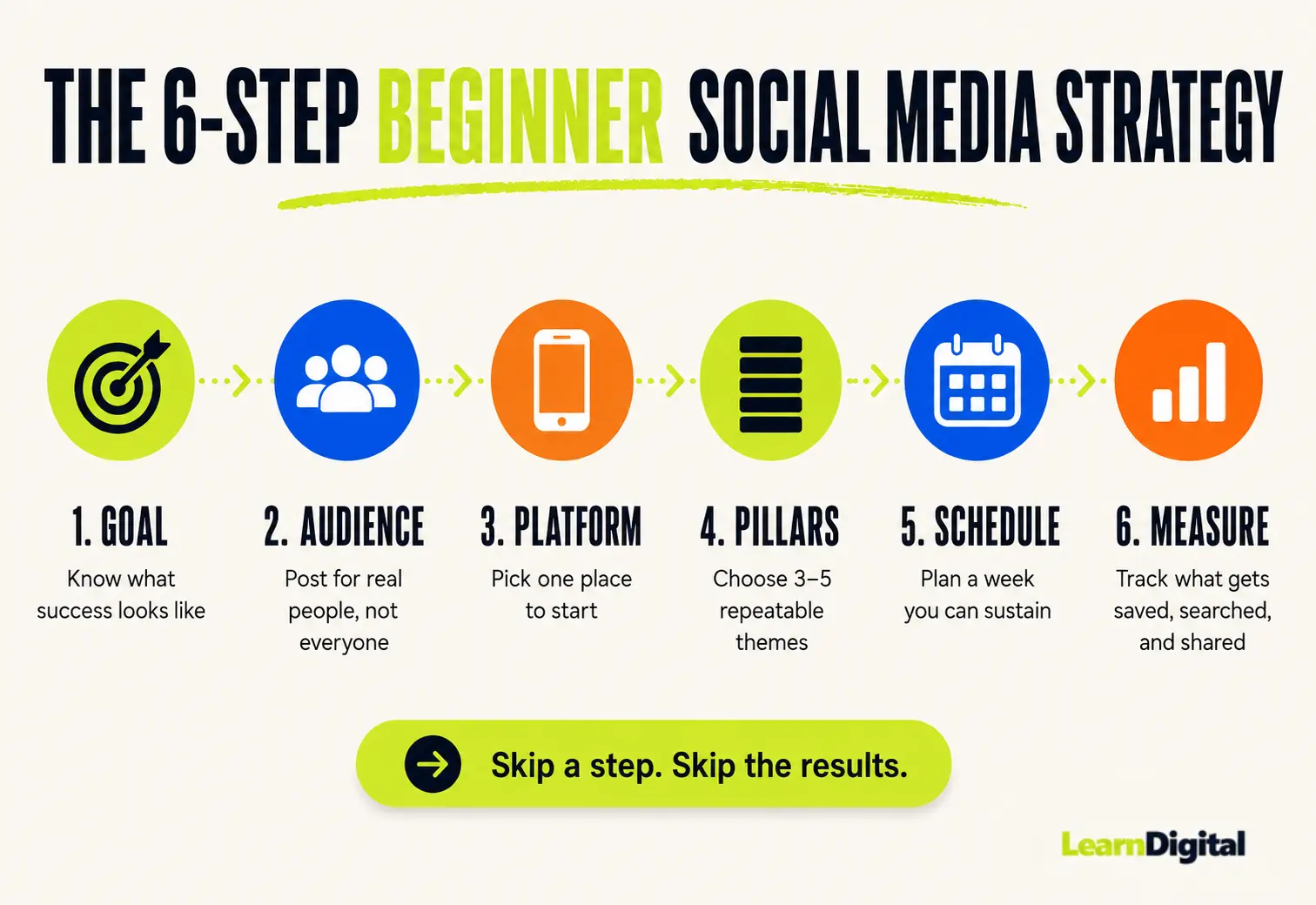
A social media strategy for beginners doesn't need to be a 40-slide deck. It needs six things. Here is the social media marketing step by step version I'd give my younger self.
1. Pick one goal
Pick one. Not three. Examples: more website visits, more email subscribers, more product sales, more comments on your posts. If you can't measure it, swap it for something you can.
2. Define who you're talking to
Not "everyone aged 25 to 55." A real person. What do they do for work, what stresses them out, what apps do they open at 7 am, what would make them stop scrolling. Write it down in two sentences. You'll come back to those sentences every time you write a caption.
3. Pick your platform
We just covered this. One to start. Two maximum.
4. Choose 3 to 5 content pillars
Pillars are the recurring themes you post about. They keep you from sitting in front of a blank screen on Tuesday morning. More on this in the next section.
5. Set a realistic schedule
Realistic means "I can do this for 6 months without crying," not "I will post 3 times a day forever starting tomorrow." Maybe 3 to 5 short videos a week. Maybe one really good post a week to start. Start lower than you think you should.
6. Measure what matters
Saves and shares matter for reach. Click-throughs matter for traffic goals. DMs and replies matter for community building. Likes are nice. They don't pay rent.
Content pillars (or, what to post when you have no idea what to post)
One of the most common questions I get from beginners is: what do I even post. Content pillars solve this. A pillar is a recurring topic or angle that your audience cares about and that you can keep making content about for years without running out.
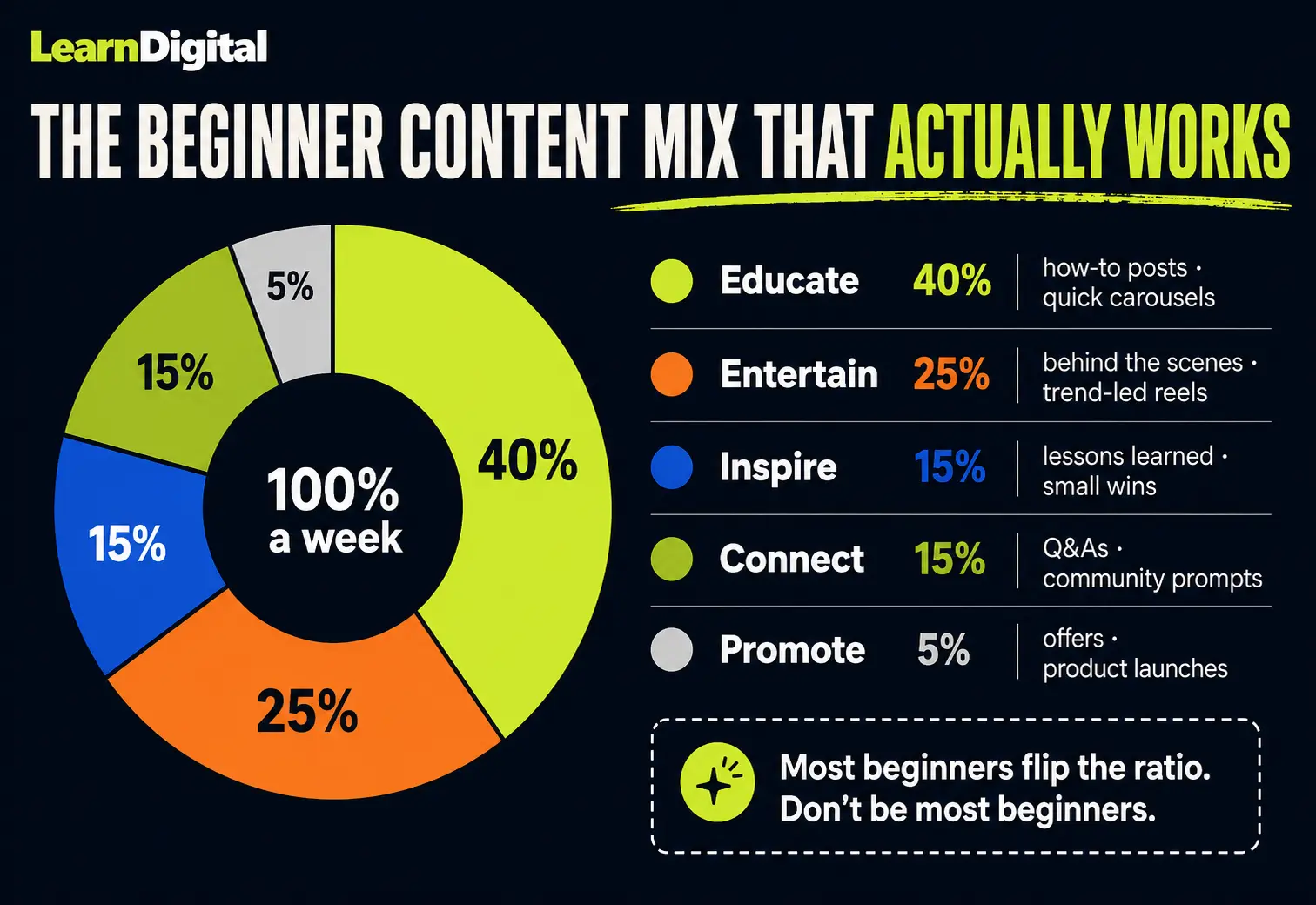
A simple beginner mix that works on almost any platform:
- Educate, around 40% of your posts. Teach your audience something useful. How-tos, tips, mistakes to avoid, mini explainers. This is what builds trust over time.
- Entertain, around 25%. Make people smile or feel something. A funny take, a relatable moment, a behind-the-scenes blooper. Entertainment is what gets people to share you with their friends.
- Inspire, around 15%. Client wins, your origin story, a transformation, a quote that actually means something. Used too much and it gets cheesy. Used right and it sticks.
- Connect, around 15%. Polls, questions, "what would you do," answering DMs in a post. Communities don't form on broadcast. They form on conversation.
- Promote, around 5%. The actual ask. Buy this, sign up, click the link. Earned by everything else.
Why such a small share for promotion? Because most beginners flip the ratio. They post 80% "buy my thing" and wonder why nobody is buying their thing. Examples of how GoPro and Duolingo built their content pillars show that giant followings can be built with almost no hard selling. The selling came after the relationship.
How often should you post? (the answer changed in 2026)
For a long time the advice was "post more, more often, all the time." That advice is mostly outdated.
The Buffer study I mentioned earlier found something quieter and more useful. Creators who grew the most weren't the ones posting daily. They were the ones posting regularly across many weeks. Showing up 20 weeks out of 26 was worth around 450% more engagement per post than showing up only 4 weeks. Consistency beats frequency, almost every time.
A separate finding adds a counter-intuitive twist: the idea that posting more does not fix bad reach (The Grid Report) matters: when your engagement drops, posting more usually makes reach worse, not better. The algorithm reads low engagement as low signal and slows your distribution further. So if your post bombs, don't panic-post three more. Take a beat. Look at what your audience actually responded to in the past 30 days. Make something closer to that.
Realistic 2026 starting cadence for a beginner:
- TikTok, Reels, or Shorts: 3 to 5 short videos a week
- Instagram Stories: daily-ish, the bar is much lower because stories are disposable
- LinkedIn: 2 to 4 posts a week, with a focus on Tuesday through Thursday
- Facebook: 3 to 5 a week, but set your expectations low because organic reach is small
- YouTube long-form: 1 a week or 1 every two weeks
Don't treat those numbers as gospel. They're starting points. If 5 a week breaks you, do 3. A consistent 3 beats an inconsistent 5 every single time.
A simple social media content plan example
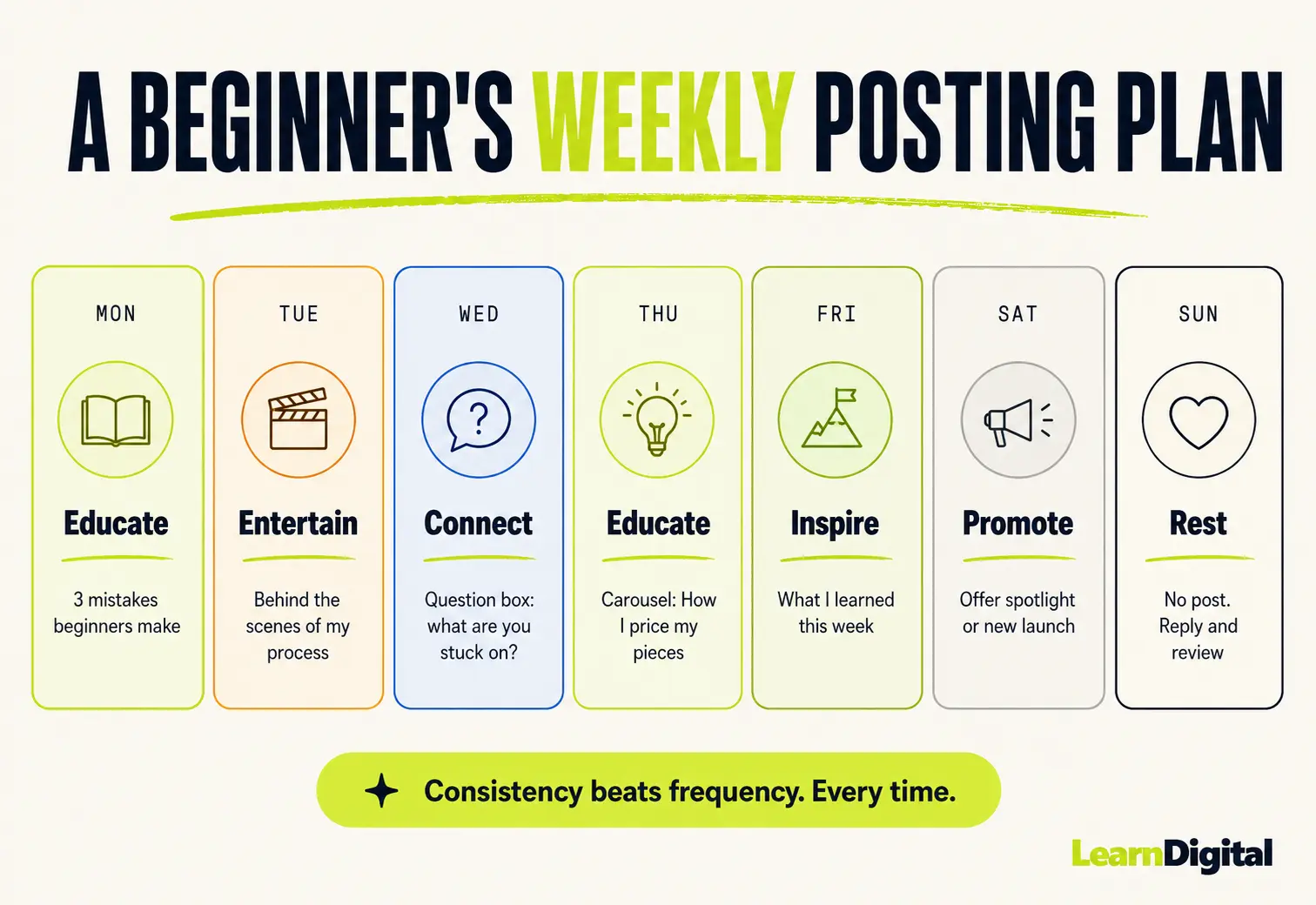
Here is what a beginner week could look like for someone selling, say, handmade ceramic mugs on Instagram. Pick your own niche and swap the topics. The structure works either way.
- Monday, educate. "3 mistakes that crack handmade ceramics in the kiln."
- Tuesday, entertain. A 15-second reel of you opening the kiln to find a disaster, sad music included.
- Wednesday, connect. A Stories poll: "Coffee mug or wine glass next?"
- Thursday, educate. Carousel: "How I price my pieces."
- Friday, inspire. A short story about why you started.
- Saturday, promote. New collection drop with the link.
- Sunday, rest, or repost a top-performing post from earlier in the month.
Seven slots, five content types, one promo. You can build a content calendar template that runs for a whole month from this base. Same pillars, fresh topics each week. If you want a step-by-step walkthrough, see how to create a content calendar with templates and examples.
How to actually grow in 2026
Three things have outsized effects on growth right now, and most beginners do them backwards.
Reply to your comments. Every one of them, for the first 6 months at least. Buffer's research kept finding the same pattern: people who reply grow faster. My non-scientific theory is that replying triggers a small moment of connection. People who feel connected come back. People who feel ignored don't. The algorithm watches that. If your engagement feels stuck even though you're posting regularly, this is usually the first thing to fix. I wrote a whole post on this called how to improve social media engagement without posting more.
Write captions and bios like a search engine query. Gen Z multi-platform search behavior (Forbes / GWI data analysis) shows that around 67% of Gen Z use Instagram for search and 62% use TikTok for search. People are typing real questions into the search bar on these platforms. If your caption says "another Monday motivation post 🔥" you're invisible to search. If it says "how I price my handmade ceramic mugs as a beginner potter," you might show up six months from now when someone searches that exact phrase. Captions and bios are SEO now.
Don't ignore long-form. The big platform story of 2025 to 2026 wasn't just short video. It was also long-form video coming back, because audiences are getting tired of 4-second cuts that don't tell them anything. Sprout Social's 2026 social media trends report notes that brands using video see 49% faster revenue growth, with short-form delivering best ROI for 31% of marketers. At the same time long-form video is making a comeback in 2026, with a parallel trend toward 5 to 15-minute videos and series-style content. If you can make one long video a month, you're already different from 80% of beginners.
Use AI tools, but stay human. Captioning tools, image editing, brainstorming hooks. AI saves real time on the boring parts. What it doesn't replace is your voice. The face people follow has to be a real face. Don't outsource your personality to a chatbot. People can smell it now.
Platform quick-look for beginners
A fast tour of the main platforms so you can pick where to start.
Facebook marketing for beginners
Organic reach for new pages on Facebook in 2026 is brutal, usually somewhere between 1% and 5%. Where Facebook still shines is community (Groups), local discovery, and paid ads with strong targeting. If your audience is 35+ and local, this is a great platform. If they're 18 to 24, lower it on your priority list. A full beginner guide is coming in a dedicated post on Facebook marketing for beginners.
TikTok marketing for beginners
TikTok is the platform where, in theory, a brand new account can go viral. In practice, that mostly happens to people who post consistently for 60+ days with hooks that grab attention in the first 1 to 2 seconds. The metric to track is TikTok watch-through rate benchmarks for 2026. A 30-second TikTok with 72% completion will outperform a 90-second TikTok with 30% completion, every time.
Instagram marketing for beginners
Reels do most of the heavy lifting for new reach. Stories build daily habit with your existing followers. Carousels still get strong saves, which the algorithm loves. Static posts are mostly for the people who already follow you. See Instagram marketing for beginners for the full setup with Reels, content ideas, and growth.
YouTube marketing for beginners
YouTube is the slowest to start of any platform on this list, and also the one where a single video can keep working for you for 3+ years. If you can make one good 8 to 15-minute video a week, YouTube can become a small business by itself. Patience required.
LinkedIn marketing for beginners
Best for B2B, recruiting, and personal brand building. Posts that mix a strong opening line, a clear point of view, and a bit of personality outperform anything that sounds like a press release.
Mistakes I see beginners make (most of which I have personally made)
Listing these partly so you don't make them, and partly because I've made every single one of them. Multiple times.
Posting and ghosting. You publish, then you close the app. You miss all the comments in the first hour, which is exactly when the algorithm is deciding if you're worth showing to more people. Stay with the post for 30 to 60 minutes after publishing.
Copy-paste-the-same-thing across every platform. Each platform has its own dialect. A great LinkedIn post is a bad TikTok caption. Repurpose, don't copy-paste. I wrote a whole post on how to repurpose content for social media without starting from scratch if you want the system.
Chasing follower counts. Followers are easy to fake and meaningless on their own. 1,000 people who reply to your DMs are worth more than 100,000 people who ghost you.
Trying to be edgy before you've found your voice. If your brand personality isn't naturally sarcastic, don't try to be Wendy's. The internet smells effort like a shark smells blood.
Quitting at week 6. The accounts that "got lucky" mostly didn't get lucky. They just didn't quit at week 6. Or week 16. Or week 30. The data is genuinely on the side of people who keep going.
A simple social media checklist for beginners
Before you publish anything, run through this. It saves a lot of "oh no, why did I post that" moments.
- One clear goal for this post (educate, entertain, inspire, connect, or promote)
- A hook in the first line or the first 1 to 2 seconds
- A reason for the viewer to keep watching or reading past the hook
- A clear takeaway or call to action
- Caption written with at least one search-friendly phrase a real person might type
- Hashtags that are relevant, not just popular (3 to 5 is plenty in 2026)
- A cover image or thumbnail that doesn't look like every other cover image in your niche
- Posted at a time your audience is actually online (check your own analytics, not generic charts)
- You're ready to reply in the first hour
Print it, screenshot it, tattoo it on your forearm, whatever helps. (Maybe don't tattoo it.)
Recap and final word
One last thing. I'm still learning this stuff too. Social media changes underneath us every quarter, and anyone who tells you they've fully figured it out is selling a course. What I do know is that the basics in this post (one platform, one clear goal, content pillars, real consistency, replying to humans) have outlasted every algorithm update I've watched, and they'll outlast the next one too. Start small, post the thing, see what happens, adjust. That's the whole game.